What Is SEO-Friendly Content? 7 Traits Google Rewards
SEO-friendly content is content created to satisfy a reader’s needs while making its subject, purpose, and value clear to search engines. It aligns with relevant search intent, provides accurate and useful information, and is easy to crawl, understand, and navigate. No format guarantees a ranking, but strong content gives search systems and people good reasons to find, trust, and use a page.
What SEO-Friendly Content Means—and Why It Matters
For a closer look at whether blogs help SEO, see what the data says about their impact on rankings. It is not simply an article with a target keyword repeated throughout; it combines relevance, usefulness, clear structure, and a sound technical foundation.
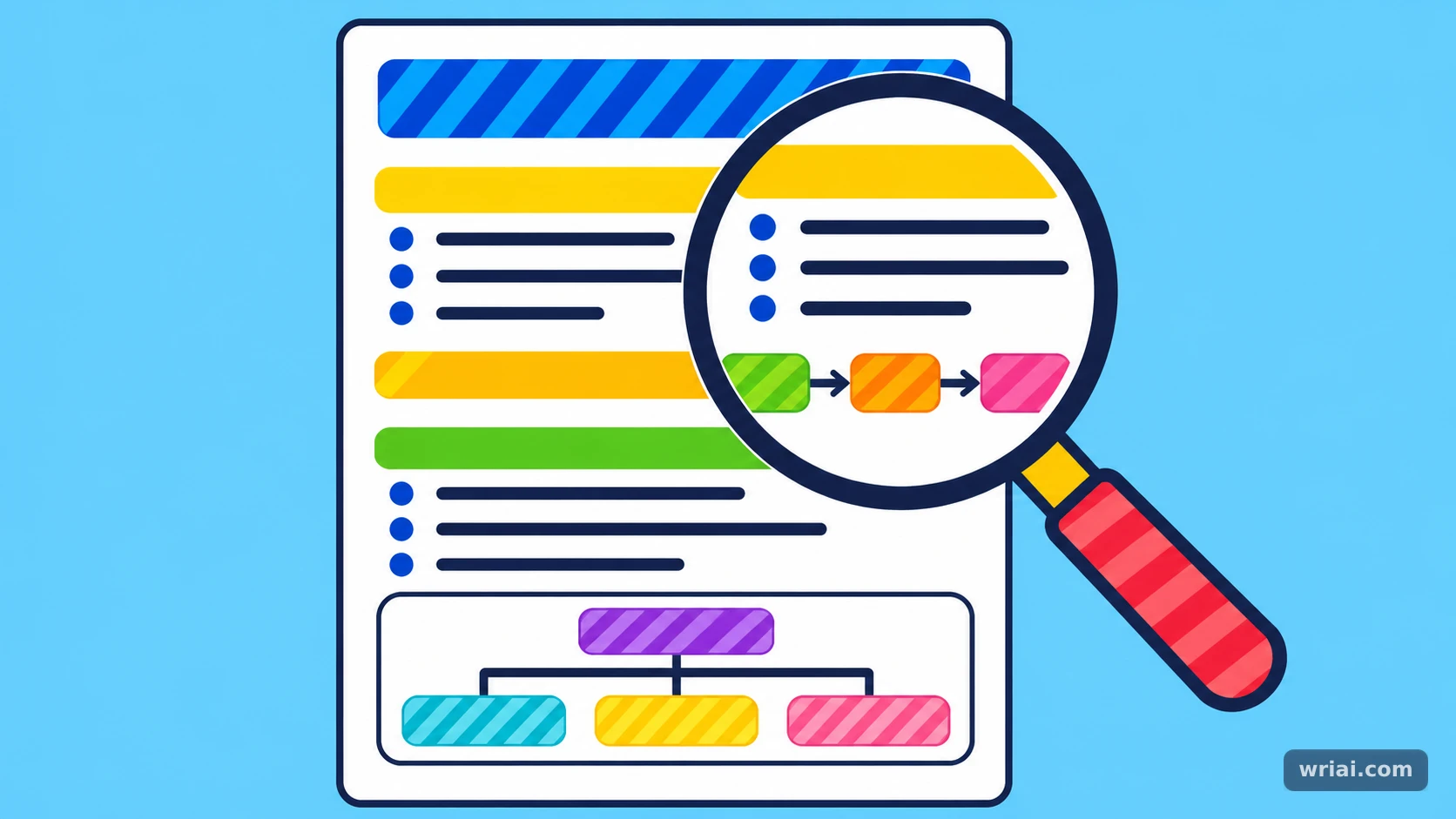 What Is SEO-Friendly Content? 7 Traits Google Rewards - A magnifying glass examining a well-structured document to represent SEO-friendly content
The seven traits that make content easier to find and use
Strong SEO content typically demonstrates seven connected traits:
- Intent alignment: It answers the question or meets the need behind a search.
- Original usefulness: It contributes relevant explanation, experience, examples, or decision support.
- Accuracy and trust: It is careful with facts, defines uncertainty, and makes its authorship clear.
- Clear organization: Headings, paragraphs, lists, and tables make the information easy to scan.
- Natural topical language: It uses relevant terms and explains related concepts without keyword stuffing.
- Helpful connections: Internal links guide readers to useful related information; external links support claims where appropriate.
- Technical accessibility: The page can be crawled, indexed, read on different devices, and loaded reliably.
These qualities reinforce one another. A technically accessible page can still disappoint if it does not answer the query, while a thorough article may struggle if search engines cannot access or interpret it.
SEO-friendly does not mean written for algorithms alone
Search optimization should clarify and strengthen a page, not distort it. A useful test is whether the content would still help someone who arrived from a direct link rather than a search result when you focus on learning seo friendly copy principles. If the answer is no, more keyword placement is unlikely to fix the underlying problem.
For example, a page targeting “how to clean a coffee grinder” should explain a safe, practical cleaning process, note relevant differences between grinder types, and help readers avoid damaging the equipment. Repeating “clean a coffee grinder” in every paragraph adds little. Clear instructions and useful distinctions do more to satisfy the likely intent.
Why it matters to readers and site owners
For readers, well-organized content reduces the effort required to find an answer, evaluate options, and decide what to do next. For site owners, it can make important pages easier to discover and connect into a coherent body of information.
SEO-friendly content also has a lifecycle. A page may need updates when facts change, when new questions emerge, or when its search performance declines. Treating publication as the finish line overlooks opportunities to improve accuracy, links, and usefulness after launch. Wriai, for example, is designed around this broader lifecycle, including content creation for seo, publishing, linking, monitoring, and decay recovery.
How to Assess SEO-Friendly Content
A practical content review checks whether each page meets its purpose, supports its claims, and works for both readers and search systems. Use the reference table below to identify what to examine and what a useful result looks like.
A practical checklist for evaluating a page
| Area to assess | What to check | A useful sign |
|---|---|---|
| Search intent | What task, question, or decision does the query imply? | The page answers the main need directly rather than drifting into unrelated topics. |
| Topic coverage | Are the essential subtopics and relevant caveats included? | A reader can make progress without needing basic context from several competing pages. |
| Accuracy | Are claims supportable, current where necessary, and properly qualified? | Facts are distinguished from opinion, and uncertainty is not presented as certainty. |
| Original value | Does the page add practical detail or meaningful explanation? | Examples, comparisons, steps, or informed observations make it more useful than a generic summary. |
| Structure | Are headings descriptive and sections logically ordered? | Readers can scan the page and find the answer or next step quickly. |
| Keyword use | Do the title and wording clearly establish the subject? | Important terms appear naturally, with related vocabulary used where it helps explain the topic. |
| Internal links | Do links point to relevant next steps or supporting explanations? | Anchor text describes the destination, and links help readers navigate the site. |
| External support | Do sources support claims that need evidence? | Links lead to credible, relevant references rather than being added for appearance. |
| Accessibility and usability | Can people read and navigate the page across common devices and assistive tools? | Text is legible, links are understandable, and meaningful images have appropriate descriptions. |
| Technical access | Can search engines access the page and its important resources? | The page is not unintentionally blocked and can be rendered and indexed appropriately. |
| Maintenance | Is the content still accurate and useful? | Outdated details, broken links, and declining sections are reviewed and improved. |
Use the table as a diagnostic, not a ranking formula
The table is a decision aid, not a scoring system that predicts positions. A page can meet many checks and still be less relevant than another result for a particular search. Search results depend on the query and the available pages, and no checklist can guarantee visibility.
Start with the largest gap between the page’s promise and its delivery. If the title promises a comparison but the page only describes one option, fix the content mismatch before polishing minor wording. If the page is comprehensive but difficult to scan, improve the hierarchy and navigation. If useful information is missing, adding substance is more important than adjusting keyword frequency.
How to choose evidence and supporting links
Use evidence where it helps readers verify or apply a claim. For instance, a page about a product’s care requirements should distinguish the manufacturer’s instructions from general advice. A page explaining an industry concept may link to an authoritative definition or primary documentation when readers need to check terminology.
Internal links serve a different purpose: they connect related pages on the same site. Link from a general explanation to a genuinely useful deeper guide, and use descriptive anchor text rather than vague phrases such as “click here.” For a broader foundation, see this guide to what SEO writing involves.
How to Create SEO-Friendly Content Step by Step
Creating SEO-friendly content is a repeatable process: understand the query, plan a useful answer, produce and review the page, then publish and maintain it. The sequence helps prevent teams from spending time polishing content that targets the wrong need.
Step 1: Identify the reader’s task and the right page type
Begin by asking what someone is trying to accomplish with the search. Are they looking for a definition, a practical tutorial, a comparison, or help solving a problem? The page should match that purpose. A “what is” query usually calls for a concise explanation followed by context and examples; a “how to” query usually needs ordered instructions and relevant precautions.
Look at the wording of the query, the topic, and the kind of answer that would genuinely help. Search results can provide clues about common formats and subtopics, but they should not be copied as a template without judgment. The objective is to understand the need, not to reproduce competitors’ pages.
Step 2: Research the topic and plan the answer
Gather the information required to answer the query accurately. Separate facts that need verification from general explanation, and identify likely follow-up questions. Then build an outline that moves from the direct answer to supporting detail and practical application.
For an article about SEO-friendly content, a useful plan might cover the definition, characteristics, assessment criteria, a creation process, common mistakes, and different use cases. That organization serves both readers who need a quick explanation and readers who want to apply the ideas.
Alex Vance’s experience in SEO and content automation informs a useful planning principle: define the page’s job before drafting. This makes it easier to decide what belongs in the article, what should be linked elsewhere, and what would be distracting detail.
Step 3: Draft for clarity, completeness, and credibility
Put the central answer near the beginning, then develop it in a logical order. Use headings that describe the section’s contents, short paragraphs for readability, and lists or tables when they genuinely make information easier to compare or follow.
Support the reader with relevant specifics. A tutorial should explain the steps, not merely name them. A comparison should identify meaningful differences, not present two lists of benefits. An explanatory article should define unfamiliar terms and distinguish established information from interpretation.
Review claims carefully. If you cannot support a precise statement, qualify it or remove it. Make authorship and perspective clear where relevant, and avoid implying that a page’s presence in search proves its claims are correct.
Step 4: Optimize the page without forcing keywords
Write a title and introduction that accurately represent the page. Include the topic’s main wording naturally where it helps readers understand the subject, and use related terms when they add meaning. There is no need to force an exact phrase into every heading or paragraph.
Then improve the page’s practical usability:
- Add internal links to relevant guides or next steps.
- Use descriptive link text that sets expectations.
- Provide meaningful alternative text for informative images; leave decorative images without unnecessary descriptions where the publishing system allows.
- Check that headings are in a sensible order and that tables are readable on small screens.
- Confirm that the page is accessible to search engines and that important content is not hidden unintentionally.
A detailed guide to SEO content writing practices can help with editorial review, but no list should replace checking whether the page answers its specific query.
Step 5: Publish, monitor, and improve
Publication begins the measurement and maintenance stage. Review available performance data to understand whether the page is earning visibility and attracting relevant visitors. Where suitable, website and Google Search Console data can help identify queries, impressions, clicks, and pages that may need attention.
If a page’s performance declines, investigate before rewriting it. The cause may be outdated information, a change in reader needs, weak internal connections, or a mismatch between the title and the page. Refresh the sections that no longer serve readers, verify facts and links, and preserve content that remains useful. Automation platforms such as Wriai can support parts of this lifecycle, including publishing, linking, indexing workflows, and content decay monitoring, but editorial judgment remains important.
Common Mistakes, Better Examples, and Expert Tips
Many weak pages are not missing keywords; they are missing a clear purpose, useful detail, or a reason to trust the answer. Improve the reader’s experience first, then check whether the page communicates its subject clearly to search systems.
Avoid these common SEO content mistakes
Writing to a keyword instead of a person’s need often produces repetitive, thin copy. A page targeting “best indoor plants for low light,” for example, should help readers understand which plants fit the conditions and what care differences matter. A keyword repeated in each paragraph does not provide that decision support.
Covering too much without a clear focus can make an article feel comprehensive but hard to use. Keep the page centered on its main task, and link to separate guides when a related subject deserves fuller treatment.
Treating word count as a quality signal is another trap. A longer article is not automatically more helpful. Add detail when it answers a question, clarifies a distinction, or supports an action—not to reach an arbitrary length.
Other mistakes include making unsupported claims, using generic headings, adding irrelevant links, and allowing old advice to remain after it becomes misleading. A review should consider what a reader needs to know, what the page actually provides, and what should be corrected or removed.
Turn a generic explanation into a useful page
Consider two approaches to the query “how to prepare for a job interview.” A weak page might repeat general encouragement and list vague advice such as “be confident.” A stronger page can explain how to research the role, prepare relevant examples, practice likely questions, and plan practical details. It might also distinguish a first interview from a technical interview, where preparation needs differ.
The stronger page does not need to claim that its advice guarantees a job offer. It needs to give readers clear, credible ways to prepare. That is the key distinction between content that merely resembles an answer and content that helps someone act.
The same principle applies to a definition page. Define the term plainly, explain why it matters, identify important components, and show how a reader can assess or apply it. Then link to a deeper tutorial if the next task requires more detail.
Use expert judgment to decide what to improve first
Prioritize changes by their likely usefulness, not by how easy they are to implement. If the page answers the wrong question, revise its scope and structure. If the information is sound but difficult to navigate, improve its headings, introductory answer, and internal links. If a key claim lacks support, verify it before focusing on cosmetic edits.
Alex Vance’s practical observation is that content quality depends on the whole workflow, not just the drafting stage. Research, editorial review, publishing, linking, and later maintenance all affect whether a page remains useful. Wriai’s closed-loop approach reflects that lifecycle, but the principle applies equally to manual teams: assign responsibility for reviewing important pages after publication.
Choose the Right Approach for Your Content Situation
The best SEO process depends on the site’s goals, team capacity, and the type of information being published. A solo publisher may need a simple checklist, while an agency managing many pages may need defined review and update workflows.
If you are creating your first pages
Start with a small set of pages that serve distinct reader needs. Make each page’s purpose clear, connect related pages with useful internal links, and avoid publishing many near-identical articles that differ only in keyword wording. A focused collection with meaningful coverage is easier to maintain than a large set of overlapping pages.
Before publishing, ask someone unfamiliar with the draft to locate the main answer and explain what they would do next. If they cannot find the key information quickly, revise the introduction or organization.
If you manage an established site
Review existing content before creating more. Look for pages that overlap, no longer reflect current information, or receive attention but fail to meet the reader’s likely need. Updating, consolidating, or better connecting a useful page may be more valuable than producing another article on the same topic.
Use website and Google Search Console data as evidence, not as a substitute for reading the page. Performance patterns can highlight where to investigate, but editorial review is needed to determine why a page is underperforming and what change would help.
If you work with a team or at scale
Set consistent standards for research, fact-checking, structure, internal links, publishing, and maintenance. A workflow helps prevent avoidable omissions, but it should preserve human review for claims, sensitive topics, and decisions that require subject expertise.
Automation can reduce repetitive work across large content libraries. For example, Wriai combines opportunity discovery, content planning, creation, publishing, linking, distribution, and decay monitoring in an SEO workflow. Whether tasks are automated or handled manually, teams should verify that the resulting pages are accurate, genuinely useful, and appropriate for their audience.
FAQ
Is SEO-friendly content the same as content optimized for keywords?
No. Keywords can help clarify a page’s subject, but SEO-friendly content also needs to meet the searcher’s intent, provide useful and accurate information, and be accessible and well organized. Repeating a phrase without answering the underlying question does not make a page helpful. Use the language readers use where it fits naturally, then focus on delivering the explanation, comparison, or instructions they came for.
Does longer content rank better in search?
Not automatically. Length should follow the task: a simple question may need a concise answer, while a complex decision may require comparisons, examples, and caveats. Adding paragraphs that do not help the reader can make a page harder to use. Instead of targeting a word count, check whether the page covers the essential parts of the query and whether each section contributes useful information.
How often should SEO content be updated?
There is no single update schedule that fits every page. Review content when important facts may have changed, when readers’ needs shift, when links stop working, or when performance data indicates a reason to investigate. Some evergreen explanations may remain accurate for a long time; time-sensitive pages need closer attention. Update only what needs improvement, and verify that revisions preserve or increase the page’s usefulness.
Can AI generate SEO-friendly content?
AI can assist with research, planning, drafting, optimization, and workflow tasks, but generated text is not automatically accurate or useful. Review claims, confirm that the page meets the intended search need, and add relevant expertise and examples. At scale, automation can support publishing, linking, monitoring, and content maintenance as well as writing. The final standard should remain the same: the page must help its audience and present information responsibly.
Alex Vance
Head of AI SEO & Autonomous Growth Systems
Specialist with 9+ years of experience in algorithmic search engine optimization, semantic knowledge graphs, and large-scale LLM automation.